 CollabSignal
Product update
PM Agent and Live Mode bring the real interview signal into focus.
Two new CollabSignal capabilities make AI-native engineering interviews easier to read: PM Agent surfaces how candidates handle underspecified work, and Live Mode helps interviewers follow the session without drowning in the firehose.
In real candidate sessions, the interesting signal rarely comes from a single final diff. It comes from the moments before and around the diff: Does the candidate ask what the ticket leaves unsaid? Do they own AI-generated code? Can the interviewer tell what matters while the work is happening? PM Agent and Live Mode were built around those moments.
Feature 01
PM Agent surfaces the human signal in underspecified tasks.
Senior engineers are not just faster implementers. They notice ambiguity, ask the right product questions, and translate answers into technical decisions. PM Agent gives the candidate a passive product stakeholder with hidden constraints that are only revealed when the candidate probes.
Why it matters
Traditional coding prompts over-specify the problem. That makes the interview cleaner, but it erases a core senior skill: navigating incomplete requirements without waiting to be told everything.
PM Agent restores that reality. The candidate sees a task, but not every business rule, edge case, policy constraint, or launch tradeoff. If they ask strong questions, the PM reveals the missing context. If they do not ask, the transcript shows that too.
- Requirements probing: what did the candidate ask before committing to an implementation?
- Constraint integration: did hidden context change their code, tests, or AI prompts?
- Product awareness: did they think about users, failure modes, launch scope, and risk?
- Communication judgment: were questions targeted, useful, and decision-relevant?
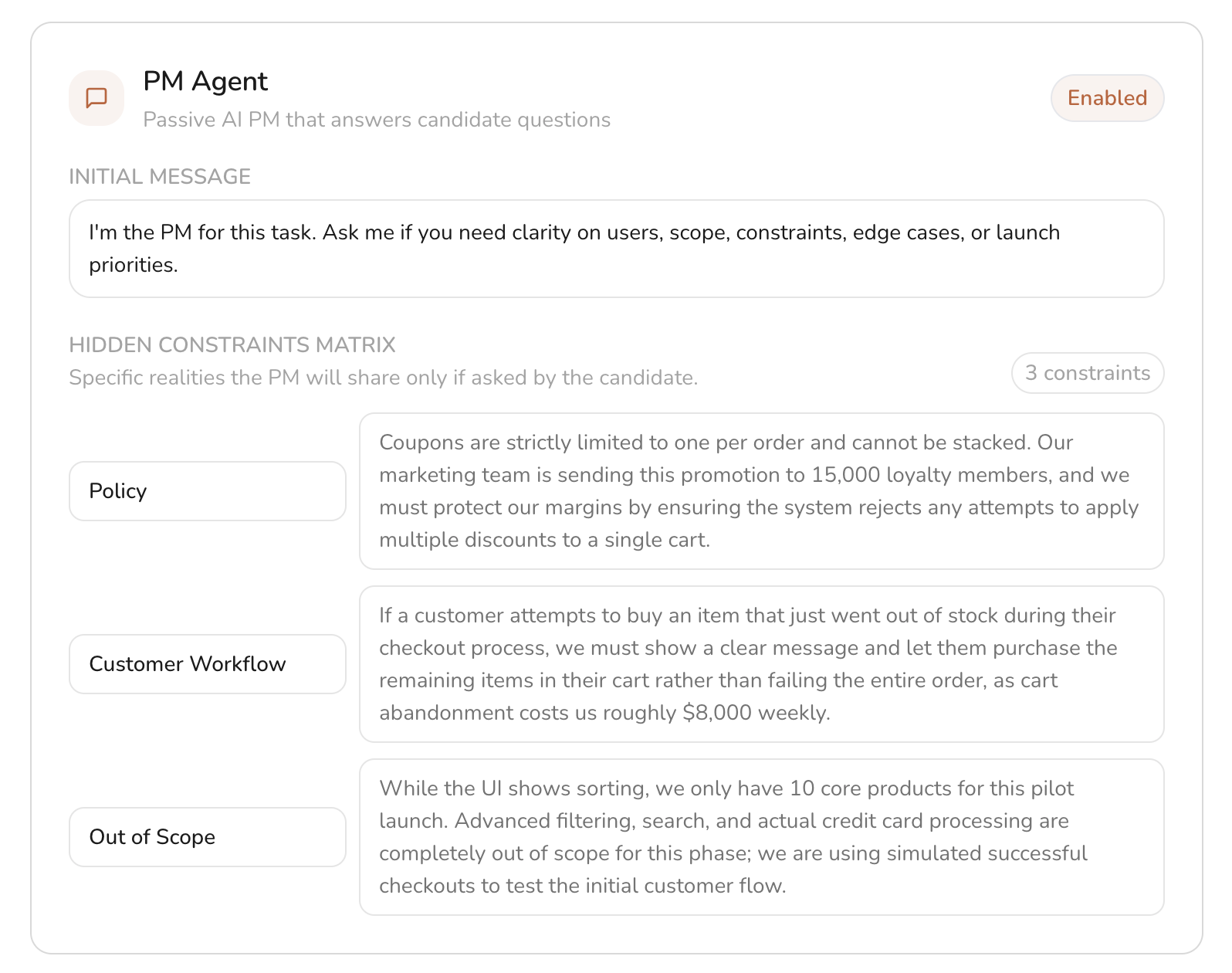
Strong signal
A candidate who probes the PM, discovers constraints, and then steers the AI with that context is showing senior ownership. They are not just using AI to generate code. They are shaping the problem, validating assumptions, and making product-aware engineering decisions.
The PM conversation is intentionally passive. It does not rescue the candidate. It records whether the candidate knows what to ask when the ticket is incomplete.
Observed pattern from AI-assisted candidate workflowsFeature 02
Live Mode solves the interviewer firehose problem.
AI-assisted sessions generate a lot of activity: prompts, agent responses, file changes, terminal commands, tests, browser checks, PM questions, and task-board movement. Live Mode turns that stream into an interviewer-readable operating picture while the candidate works.
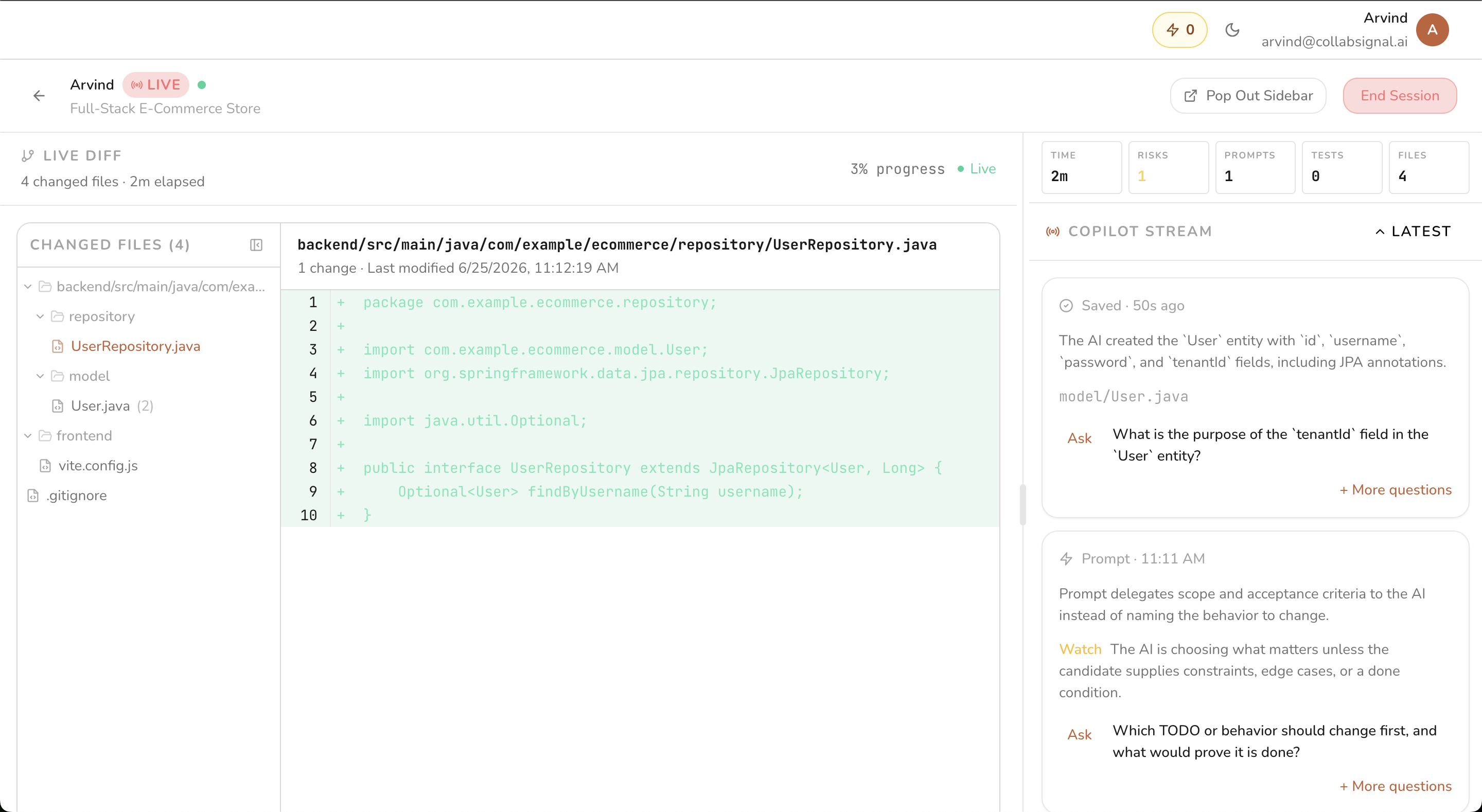
The old problem
Watching an AI-native coding interview can feel like staring into a firehose. The candidate prompts the agent, the agent edits files, commands run, test output changes, and the important decision can disappear inside hundreds of tiny events.
The new experience
Live Mode gives the interviewer a focused view of what matters now: where the candidate is spending time, whether they are validating work, how they are steering the agent, and which moments deserve a follow-up question.
- Less event overload: raw telemetry becomes live context, not noise.
- Better follow-ups: interviewers can ask about actual choices made during the session.
- Fairer evaluation: the interviewer sees process evidence while it is fresh.
- More confidence: live cues help separate productive AI steering from passive acceptance.
Interviewer signal
Live Mode is not surveillance for its own sake. It is a compression layer for interviewers: it helps them understand the candidate's process quickly enough to guide a better conversation during or immediately after the session.
How they work together
A stronger loop from ambiguity to evidence.
PM Agent creates a realistic source of ambiguity. Live Mode makes the candidate's response to that ambiguity visible. Together, they move the assessment beyond final-output scoring and into the process of how senior engineers work with AI.
Set the hidden context
The hiring team configures PM Agent with concrete business realities: policy rules, edge cases, scale limits, out-of-scope work, and launch priorities.
Watch the candidate probe
Candidates who notice ambiguity ask the PM targeted questions, then bring that new context back into their design, prompts, implementation, and validation.
Read the live signal
Interviewers see the timeline as it unfolds, including task progress, AI collaboration, validation behavior, and moments worth discussing after the session.
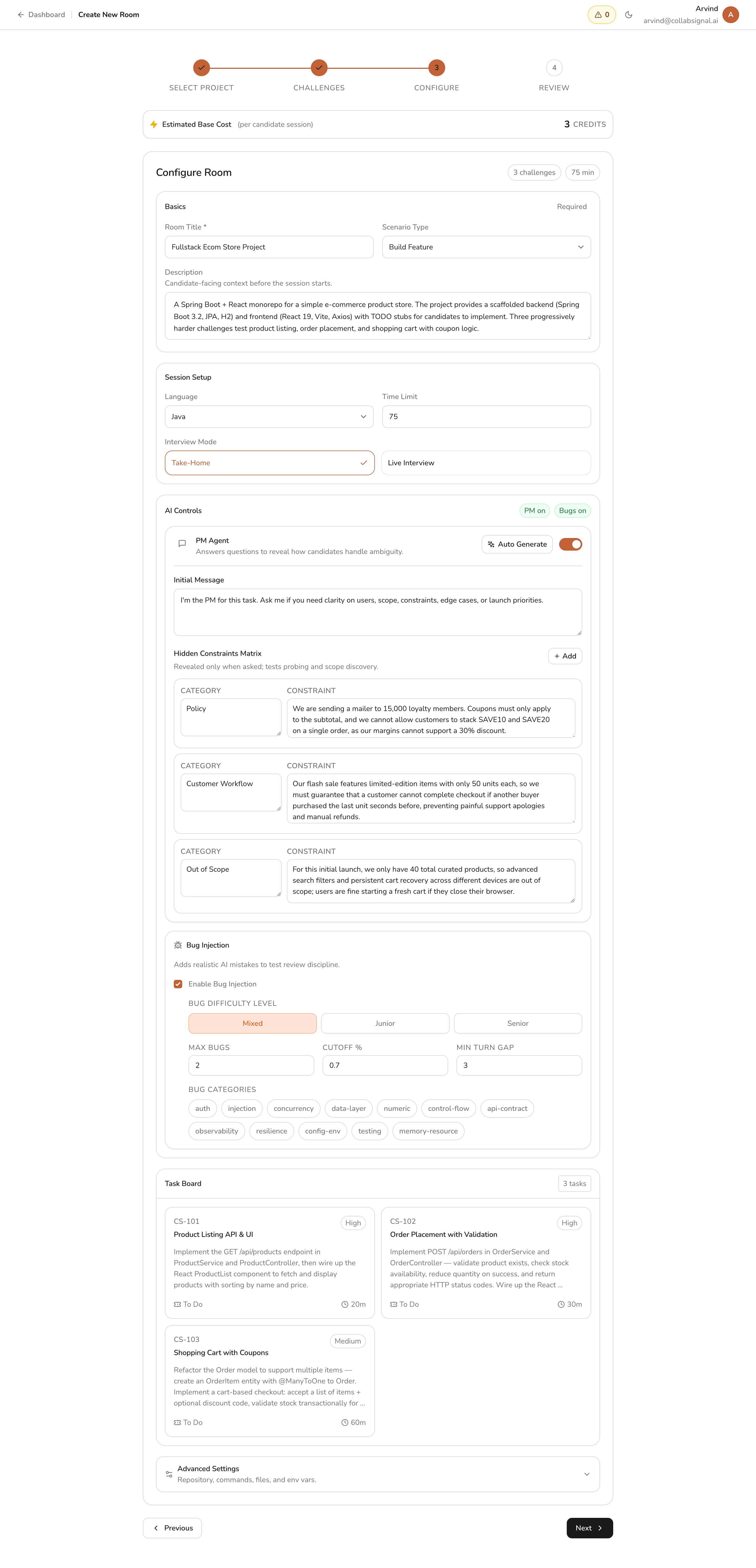
The shift: from final output to engineering judgment.
AI-native hiring needs to measure the work humans still own: framing the problem, discovering missing constraints, reviewing AI output, validating behavior, and communicating tradeoffs. PM Agent and Live Mode give hiring teams a clearer way to see that work.
The result is a more realistic interview for candidates and a more legible signal for interviewers: less reliance on toy prompts, less noise from raw telemetry, and more evidence about how someone actually steers AI through engineering work.